Projects
Selected PFAS projects worldwide.
Publicly documented projects illustrate where the market is moving: soil washing, drinking-water treatment, emergency response, destruction demonstrations and regional remediation.
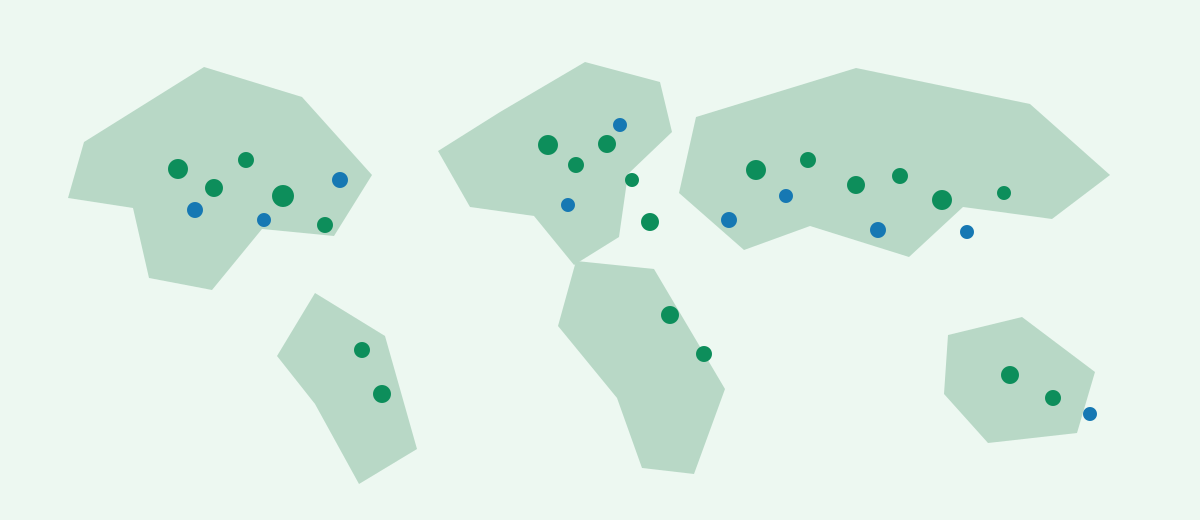
Publicly documented projects illustrate where the market is moving: soil washing, drinking-water treatment, emergency response, destruction demonstrations and regional remediation.
The facility is designed to process about 200,000 tonnes of PFAS-contaminated soil over three years. Schiphol reports roughly 80% reusable sand and 20% PFAS-containing residual sludge from the process.
Primary/project source ↗
IBA is coordinating a European LIFE project intended to demonstrate a more sustainable, scalable PFAS remediation chain across different contaminated matrices.
Primary/project source ↗ERDC modified its TREAT facility to support validation of a thermal-plasma Free Radical Gasification system for legacy AFFF and PFAS contamination.
Primary/project source ↗
SUEZ and the Rhône-Sud drinking-water authority are upgrading six activated-carbon filters with Carbazur® Simplex technology for a plant serving about 170,000 people.
Primary/project source ↗Xylem/Evoqua documents PFAS-selective ion-exchange treatment used to return impacted wells to service for Santa Clarita Valley Water Agency.
Primary/project source ↗Arcadis reports investigation of airport-related PFAS impacts, removal of 15,000 tonnes of impacted soil and a GAC water-treatment system capable of treating up to 20 litres per second.
Primary/project source ↗Tetra Tech documents PFAS treatment designs for Orange County water agencies, including ion-exchange systems that enabled multiple groundwater wells to return to service.
Primary/project source ↗AECOM reports regional transport modelling plus field pilots that tested PFAS separation and destruction technologies to support long-term remedial decision-making.
Primary/project source ↗Arcadis reports treating about 400 m³ of PFAS-impacted firefighting water on site using activated carbon for a terminal operator in the Amsterdam port region.
Primary/project source ↗Arcadis reports an emergency project following a firefighting-foam release that included a treatment plant commissioned within five weeks and treatment of more than 15 million litres of impacted water.
Primary/project source ↗Help build an independent global directory of PFAS solutions, projects and expertise.